India's industrial water reckoning: why reuse is now a board-level risk
Water demand in India is on track to outrun supply within this decade. For industry, that turns reuse from an environmental nicety into a question of whether a plant can keep running at all.

Water risk used to be a regional emergency. It is now a national, macroeconomic one — and for any company that runs a water-intensive process, it has become a board-level question.
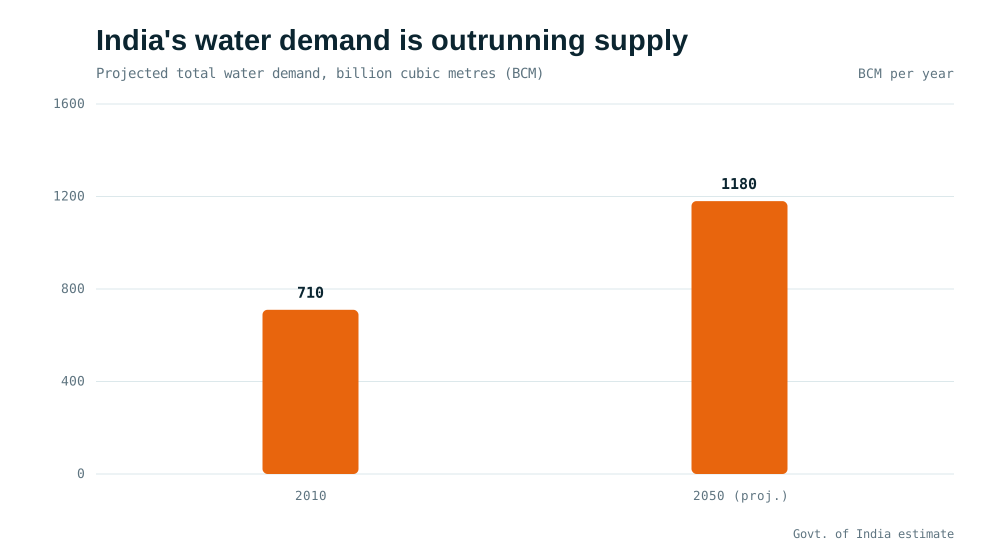
The Government of India has projected national water demand to rise from about 710 billion cubic metres (BCM) in 2010 to roughly 1,180 BCM by 2050, with industrial and domestic use growing fastest. NITI Aayog's Composite Water Management Index has gone further, warning that by 2030 India's water demand could be twice its available supply, implying severe scarcity and a potential loss of up to 6% of GDP.
The groundwater that industry quietly leans on
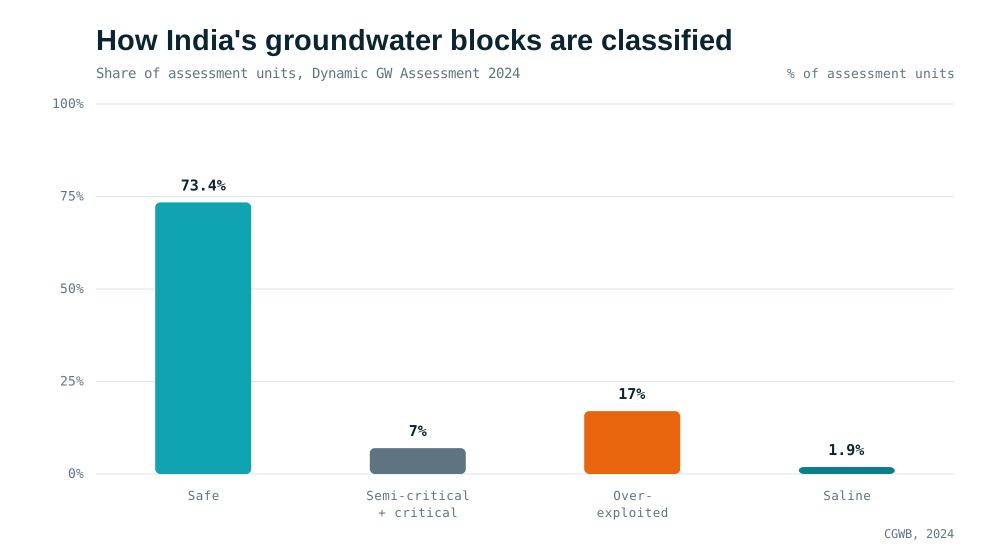
Most industrial sites draw, directly or indirectly, on groundwater — and the national picture there is mixed. The Central Ground Water Board's Dynamic Ground Water Resource Assessment 2024 put annual extraction at 245.64 BCM against recharge of 446.90 BCM, an overall stage of extraction around 60%. The headline improvement is real: 73.4% of assessment units are now rated "Safe", up from 62.6% in 2017.
But the averages hide the stress that matters to a factory siting decision. Around 17% of assessment units remain over-exploited, concentrated in the north-west, western arid belts and parts of the peninsula.
For a plant in Gujarat, the local detail is sharper still: a CGWB assessment found salinity affecting 28 of the state's 33 districts. Coastal over-pumping pulls saline water into aquifers, quietly raising the TDS of the very borewell a factory depends on.
Why this lands on the operations agenda
- Supply continuity. When a cluster's groundwater is restricted or a municipal allocation is cut, a plant that recycles its own water keeps running while neighbours throttle back.
- Rising feed TDS. As aquifers salinise, the raw water gets harder to treat — yesterday's softener may not make tomorrow's boiler-feed spec.
- Regulatory direction. Reuse and zero-discharge expectations only move one way. Building reuse in now is cheaper than retrofitting under a deadline.
The cheapest cubic metre of water a factory can secure is the one it already paid for once and recovers, instead of pulling a fresh one out of a stressed aquifer.
What "designing for reuse" looks like
It rarely means a single big machine. It means treating the site as a water system: mapping every stream, matching the quality each use actually needs (cooling and washing do not need permeate), and recovering at the highest point that makes economic sense. A reverse-osmosis train turns marginal borewell or treated-effluent water into process-grade supply; the reject is minimised, not ignored.
The numbers behind the risk
The macro picture is stark. The Central Ground Water Board's 2024 assessment put India's annual groundwater extraction at roughly 245 billion cubic metres. About 73% of assessed units are still rated 'Safe', but close to 17% are 'Over-Exploited' — and those over-drawn blocks cluster precisely in the industrial and agricultural belts that drive output. Layer on the structural imbalance — India holds about 4% of the world's freshwater for nearly 18% of its people — and the trajectory is clear. NITI Aayog has warned that national water demand could be roughly twice available supply by 2030, with a meaningful slice of GDP exposed.
What it looks like on a P&L
For a water-intensive operation, that abstraction becomes very concrete. The cost of the input itself rises — deeper bores, more pumping energy, tanker top-ups in the dry months. The risk of an unplanned production stoppage rises with it, and a single shutdown can dwarf a year of treatment opex. Lenders and large customers increasingly ask for water and ESG disclosures, so the issue reaches the cost of capital and the order book, not just the utility bill. Reuse changes the shape of that exposure: it converts a variable, rising, uncertain cost into a capital asset with predictable operating costs and a known output of water.
The reuse hierarchy
The cheapest litre is the one not used. Sensible programmes work down a hierarchy: first cascade water through uses of falling quality (potable → process → cooling → flushing); then treat and recycle with UF/RO where a stream can be closed; and only then move to ZLD where discharge is genuinely constrained. The engineering principle throughout is to match treatment to the lowest quality each use can accept, rather than polishing everything to drinking standard out of habit.
The companies that treat this as infrastructure — not a compliance line item — are the ones that will still have water to run on when the 2030 supply gap that NITI Aayog warned about actually arrives.