PFAS and the next wave of water regulation
The 'forever chemicals' have moved from research papers to enforceable drinking-water limits. The technologies that remove them are ones the water industry already knows well.
Per- and polyfluoroalkyl substances — PFAS, the so-called "forever chemicals" — are the contaminant the global water industry has spent the last two years bracing for. Prized in manufacturing for their resistance to heat, water and oil, those same properties make them extraordinarily persistent in the environment, and they are now turning up in water supplies worldwide.
Regulation has arrived
In 2024 the US EPA finalised its first national drinking-water limits for PFAS, setting maximum contaminant levels as low as 4 parts per trillion for PFOA and PFOS. To put that in perspective, that is a handful of drops in an Olympic pool. The compliance timeline was extended by two years in 2025, and in September 2025 the agency kept the core PFOA/PFOS standards while reconsidering limits for some other compounds — but the direction is unmistakable. An NRDC analysis estimated more than 73 million Americans are exposed above EPA thresholds.
India has not yet set enforceable PFAS limits, but the pattern of the last decade — global norm, then domestic adoption — makes this a contaminant worth understanding before it is mandated, not after.
The good news: the tools are familiar
The EPA named three Best Available Technologies for PFAS removal, and water engineers already run all three: granular activated carbon (GAC), anion exchange (ion exchange), and high-pressure membranes (reverse osmosis / nanofiltration).
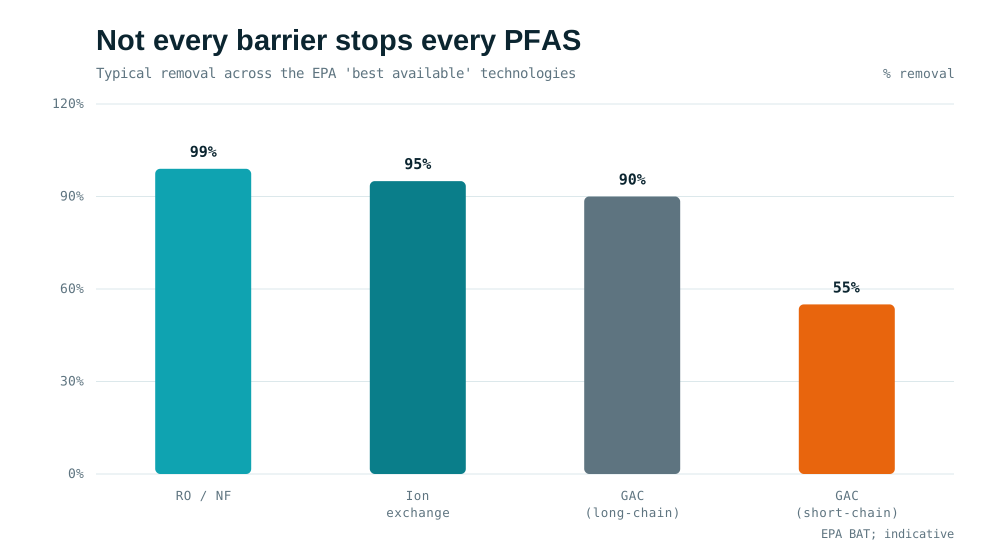
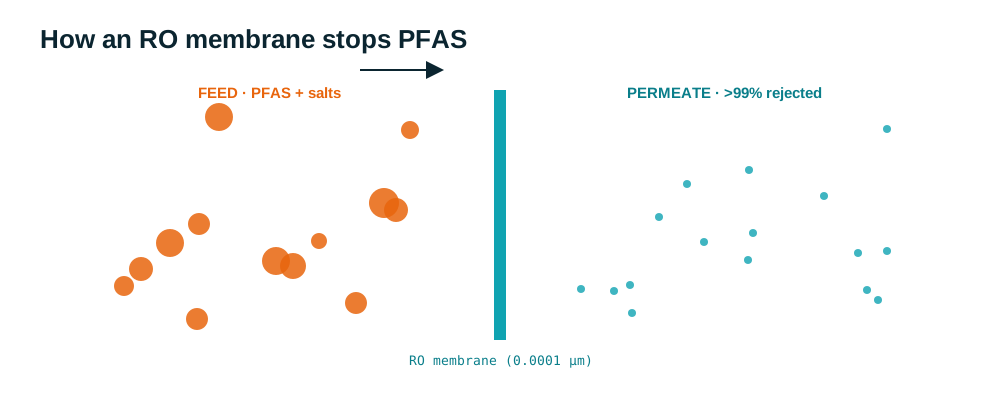
Each has a niche. Reverse osmosis is the broadest barrier — it physically rejects more than 99% of most PFAS and tolerates difficult water chemistry that would foul a resin. Ion exchange is compact (roughly a quarter of GAC's footprint) and effective, but needs clean feed. GAC is well understood and widely approved, but is weaker on short-chain PFAS — exactly the compounds drawing fresh regulatory attention.
Why this matters even before a mandate
- RO plants are already a PFAS barrier. A facility that runs reverse osmosis for TDS or reuse is, incidentally, removing the great majority of any PFAS present.
- Brine is the catch. RO and ion exchange concentrate PFAS rather than destroy it — the reject stream then needs proper management, which is where ZLD thinking and PFAS treatment meet.
- Pre-treatment decides cost. Iron, manganese and organics foul resins and shorten carbon life; conditioning the water first is what makes the primary barrier economical.
For most industrial sites the practical message is reassuring: the membrane train you may already run for salinity is also the most robust barrier we have against the contaminant regulators are now chasing.
What the rule actually says
In April 2024 the US EPA finalised the first enforceable national drinking-water limits for PFAS, and the numbers are vanishingly small: PFOA and PFOS at 4 parts per trillion — nanograms per litre — with limits for PFHxS, PFNA and GenX chemicals and a Hazard Index to govern mixtures. Public systems face monitoring and, where exceeded, treatment within a few years. India has not set equivalent MCLs, but the rule still travels: exporters, multinationals and their supply chains are increasingly asked to meet the standard wherever they operate, which makes it an engineering question for Indian plants too.
The three proven barriers
The good news is that the treatment is not new. Three technologies are recognised as effective: granular activated carbon (GAC), which adsorbs longer-chain PFAS well; ion-exchange resins (IX), which are particularly useful for the troublesome short-chain compounds; and reverse osmosis or nanofiltration, whose dense membranes reject upwards of 99% of many PFAS by size and charge. Each is a mature unit operation the water industry has run for decades — applied now to a molecule we have only recently learned to measure at the parts-per-trillion level.
The problem each one leaves behind
None of the three destroys PFAS; they concentrate it. GAC and IX produce spent media; RO produces a concentrate stream. Because the molecules are so persistent, that residual cannot simply be discharged — it has to be regenerated, incinerated at high temperature, or sent to controlled disposal, and destruction technologies (supercritical water oxidation, electrochemical and others) are still maturing. Designing a PFAS barrier therefore means designing for the residual from the start, not bolting on a polisher and hoping the problem disappears downstream.
The honest caveat is that no single technology is a complete answer for every PFAS in every water — short-chain compounds, high salinity and brine disposal all complicate the picture. But the engineering is not starting from zero. It is an extension of treatment trains the industry has run for decades, applied to a molecule we have only recently learned to fear.