The energy line of an RO plant: cutting the kWh per cubic metre
In a reverse-osmosis plant, the high-pressure pump is where the electricity bill is written. Feed salinity, recovery and one piece of recovery hardware decide most of it.
Ask what a reverse-osmosis plant costs to run, and the honest answer is mostly: electricity, spent at the high-pressure pump. Specific energy consumption (SEC) — the kilowatt-hours needed per cubic metre of permeate — is the number that separates an efficient plant from an expensive one.
What sets the number
SEC is driven by how hard the pump has to push, which in turn depends on feed salinity and recovery. Seawater RO is the demanding end: published 2024–25 work puts state-of-the-art large seawater plants around 2.0–2.8 kWh/m³, against a theoretical thermodynamic minimum near 1.07 kWh/m³. Brackish and industrial feeds — the water most Indian plants actually treat — sit far lower, often around or below 1 kWh/m³, because the osmotic pressure to overcome is a fraction of seawater's.
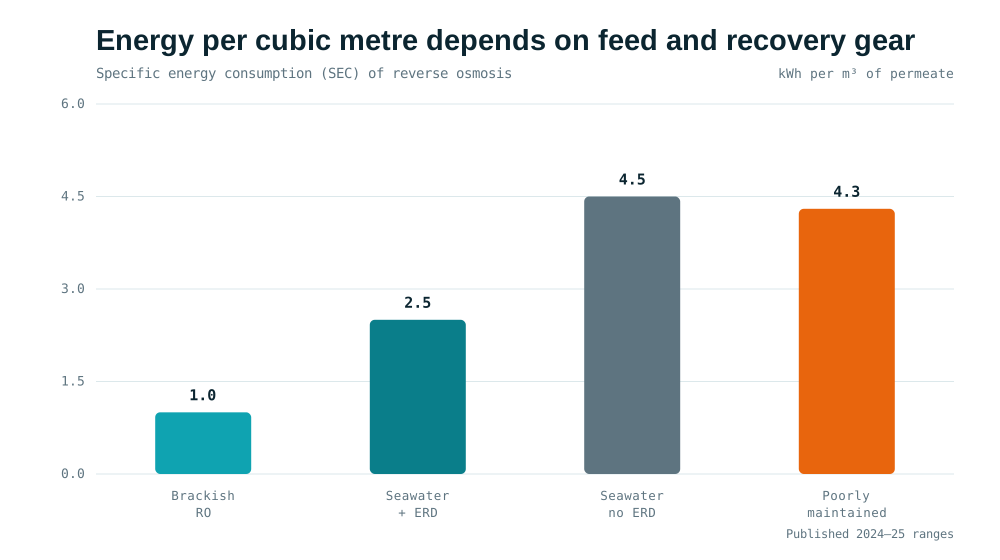
Two things in that chart are worth dwelling on. The first is how much poor maintenance costs: a documented case saw energy climb to 4.26 kWh/m³ simply because the plant was run badly — fouled membranes and worn internals make the pump work harder for the same water. The second is the gap an energy recovery device (ERD) closes.
The single biggest lever: energy recovery
In any RO system, the reject stream leaves the membranes still at high pressure. Throw it away and you throw away energy. An ERD — most commonly a pressure exchanger (PX) — captures that pressure and hands it back to the incoming feed. Modern PX units reach efficiencies up to 97%, and the literature shows them cutting seawater SEC from around 4.5 to 2.5 kWh/m³.
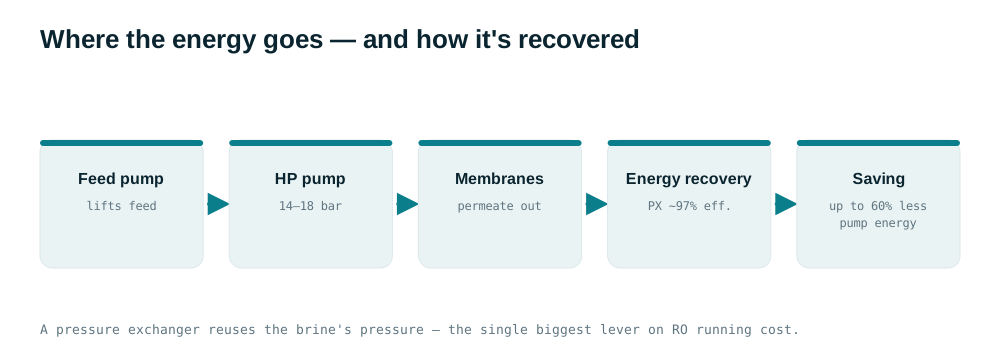
For a large plant the saving is not marginal: studies report swapping older recovery for a PX device trimming over 1 kWh/m³, which on a sizeable plant is millions of kilowatt-hours a year.
The practical checklist
You do not need a research budget to hold SEC down. You need discipline:
- Size the pump and recovery to the feed, not to a catalogue. An over-pressured system burns energy continuously.
- Use a VFD so the pump tracks the real duty as feed temperature and fouling change through the day.
- Hold design flux with pre-treatment, so the membranes never force the pump to compensate for fouling.
- Maintain on schedule. Clean-in-place on time and element replacement before performance collapses is, in energy terms, free money.
On a brackish-water skid, the difference between a well-run plant and a neglected one can be most of the energy bill — and it is decided by housekeeping, not exotic technology.
Where the kilowatt-hours actually go
Specific energy consumption is not a single dial; it is the sum of several. Pump efficiency sets the floor. Membrane condition raises it — a fouled element needs more pressure to push the same flux, so a neglected CIP schedule quietly inflates the power bill. Recovery raises it too: as you remove more permeate, the concentrate left behind gets saltier and its osmotic pressure climbs, so the feed pressure must climb to stay ahead of it. And temperature matters more than most operators expect — cold water is more viscous, flux falls roughly 2–3% per °C, and a plant designed only for summer water will strain in January.
Energy recovery, where it pays
On high-pressure and sea-water duty, the concentrate leaves the membranes still carrying most of the pressure it was given. A pressure-exchanger energy recovery device hands that energy back to the incoming feed at around 97% efficiency, which is why well-designed sea-water plants have fallen from roughly 4.5 to about 2.5 kWh/m³. On low-pressure brackish and effluent-reuse duty the pressures are far lower, so an ERD rarely pays — there the gains come from variable-frequency drives that match the pump to actual demand, from right-sizing rather than throttling, and from a two-stage array that uses pressure more efficiently across the bank.
The operating levers
None of this requires exotic hardware. Keep the membranes clean and clean them before differential pressure climbs hard; run a VFD instead of a valve to trim flow; design for the real temperature range the site sees; and resist the temptation to over-recover a water that wants to scale, because the energy to fight that scale costs more than the water it saves.
The headline figures from seawater desalination are useful context, but the lesson travels down to a 25 m³/hr industrial skid unchanged: match the hardware to the water, recover the pressure you can, and keep the membranes clean. The cheapest kilowatt-hour is the one the plant never had to draw.